
Certification scope tables
EPA 608 certification: which Fremont Sub-Zero repairs need it
Federal law reserves refrigerant-circuit work on appliances for individuals certified under Clean Air Act Section 608, and on this site that work is handled by technicians who hold EPA 608 Universal certification. The two tables below show what each certification type covers and which common Fremont Sub-Zero jobs do, or do not, trigger the requirement.
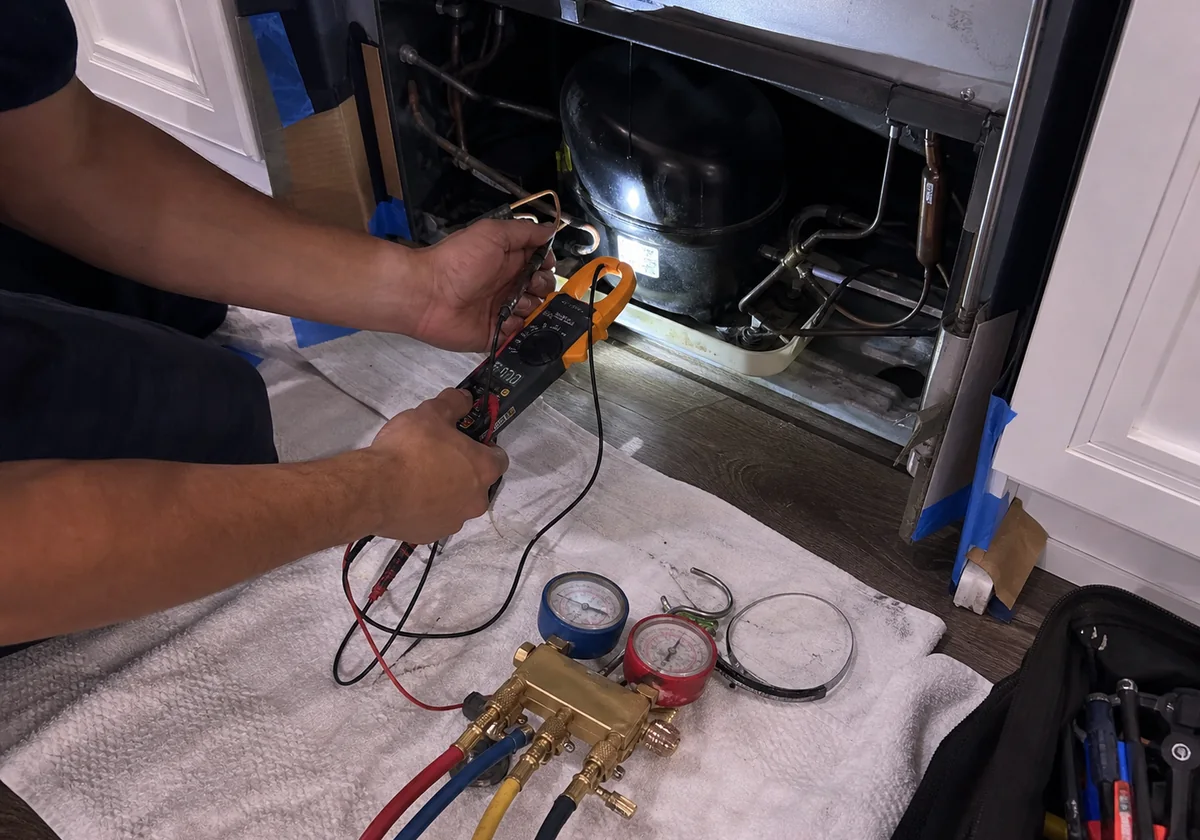
Table 1
EPA 608 Types I, II, III and Universal at a glance
EPA issues four Section 608 credentials, each tied to a class of equipment. A household refrigerator sits in the smallest class, so the table reads from the narrowest credential to the broadest.
| Credential | Equipment class it covers | What that means for a Sub-Zero in Fremont |
|---|---|---|
| Type I | Small appliances: equipment holding no more than five pounds of refrigerant that the factory charged and hermetically sealed before shipment. Home refrigerators and freezers appear in EPA's definition by name. | This is the class a household Sub-Zero belongs to, built-in or freestanding. Type I is the minimum credential for opening its refrigerant circuit. |
| Type II | High-pressure and very-high-pressure appliances serviced or disposed of in the field, such as residential split AC, heat pumps and supermarket rack systems. | Not the category a home refrigerator falls into. A claim that Sub-Zero work needs Type II misreads the equipment classes. |
| Type III | Low-pressure appliances, in practice the large chillers that condition commercial buildings. | No role in residential refrigeration. It exists in the table because Universal includes it. |
| Universal | All three classes combined. The Core exam underneath Universal must be passed as a proctored test, not an open-book one. | More than covers any refrigerant task a Sub-Zero can present. This is the credential our technicians hold. |
Certification under Section 608 belongs to the individual technician, not to any company. EPA does not certify businesses, so this page describes who on a Fremont visit may legally do what, never a company-level approval.
Table 2
Which Fremont Sub-Zero jobs require EPA 608 certification
Most Sub-Zero repairs in Fremont need no EPA credential at all. Certification becomes mandatory only when a technician attaches gauges to the sealed system, opens the loop, recovers refrigerant or recharges the unit.
| Common Fremont Sub-Zero job | Opens the refrigerant circuit? | 608 required | Detail page |
|---|---|---|---|
| Sealed-system diagnosis with gauges attached | Yes. Accessing the service ports can release refrigerant, which is the regulatory trigger. | Yes | sub-zero-sealed-system-compressor |
| Door gasket or seal replacement | No. The work stays on the door hardware and never approaches the loop. | No | sub-zero-door-gasket-seal-repair |
| Defrost heater or defrost terminator replacement | No. The defrost circuit is electrical hardware around the evaporator; the sealed loop stays closed throughout. | No | sub-zero-not-cooling-diagnostic |
| Compressor or evaporator replacement | Yes. The loop is cut open and the charge must first be recovered with approved equipment. | Yes | sub-zero-sealed-system-compressor |
| Ice maker module or water valve | No. That is the water path, a separate plumbing system. | No | sub-zero-ice-maker-water-line |
| Filter-drier replacement during a sealed-system repair | Yes. The drier is brazed into the liquid line, so the circuit is open and the charge must be recovered before the swap. | Yes | fremont-sub-zero-repair-cost-by-symptom |
| Control board or thermistor replacement | No. Electronics sit outside the sealed circuit entirely. | No | sub-zero-error-codes-alarms |
The legal test is whether the work could reasonably be expected to break the integrity of the refrigerant circuit. Hands on a gasket cannot; gauges on a service port can.
How this shapes your quote
What the yes/no mapping means for how Fremont quotes are written
Read this site's published planning ranges against Table 2 and a pattern appears: diagnostic visits at $125-$195, gasket work at $350-$850, ice maker and water-line work at $275-$850 and control or sensor diagnosis at $350-$1,250 all sit on the "no certification needed" side of the line. Only the sealed-system row, $1,300-$3,300, contains federally regulated steps, and that is part of why it is the one range quoted strictly after pressure, temperature and electrical evidence.
That split is not bureaucratic trivia; it changes what a fair Fremont quote looks like. A gasket, fan or board estimate should never be padded with sealed-system pricing, because none of those jobs involves recovery machines, a vacuum pump or refrigerant handling. In the other direction, no honest operator can promise a "quick recharge" over the phone. Recharging is circuit work, it legally belongs to a certified technician, and a Sub-Zero that lost charge has a leak somewhere that diagnosis still has to find. Topping off without finding it buys weeks, not a repair.
The do-it-yourself route is closed by the same rules. Refrigerant for stationary equipment, including R-134a in cylinders or cans intended for that use, falls under the federal sales restriction — 608 cardholders only — so a Fremont homeowner cannot lawfully buy a can and try to revive a warm built-in. That restriction is worth knowing before anyone on a marketplace listing offers to "regas" a refrigerator for cash.
Recovery duties also depend on what is inside your particular unit. Sub-Zero's own answer pages put it this way: models built before 1994 ran R-12; from 1994 onward the standard charge has been R-134a, with certain PRO models as the exception; and the refrigeration products the brand has introduced since January 2021 use R-600a. The distinction matters because federal law forbids knowingly venting R-134a, so it must be pulled into a recovery cylinder with approved equipment, while EPA exempts R-600a in household refrigerators from that venting ban. Isobutane is flammable, though, so we still pull the charge with hydrocarbon-rated recovery gear and run the job under flammable-refrigerant work procedures rather than treating the exemption as permission to be casual. Your unit's serial plate states its exact refrigerant and factory charge, which is one more reason this site asks for a model-tag photo before quoting; see the model number guide for where to find it.
Verification is simple and worth doing before you approve a four-figure sealed-system job. The credential is individual and is issued by an EPA-approved certifying organization, not by EPA itself; ESCO Institute is the largest of those bodies and runs an online lookup. Ask the technician at your door to show the Section 608 wallet card, which lists the person's name, certification type and certifying organization. The card has no expiration date because, per EPA, Section 608 credentials do not expire. One registration sits outside both tables: the state layer. The Bureau of Household Goods and Services keeps California's register of Electronic and Appliance Repair dealers, and an appliance repair business has to hold that listing; it is a business-level entry, searchable in the BHGS lookup, and it stacks with the federal technician card instead of standing in for it. How those checks fit into a visit is laid out on the technician process page, and the parts side of a sealed-system quote is covered under parts and warranty.
FAQ
Certification scope questions from Fremont Sub-Zero owners
Why does a household Sub-Zero count as Type I equipment instead of Type II?
Two facts place a unit in EPA's small-appliance class: it holds no more than five pounds of refrigerant, and the factory both charged and hermetically sealed it before it shipped. Home refrigerators and freezers appear in EPA's definition by name. A built-in Sub-Zero fits that class. Type II covers high-pressure equipment serviced in the field, such as split air conditioners and heat pumps, which is a different category of machine.
If Type I already covers refrigerators, what does Universal certification add?
Universal means the technician has passed the core section and every type section, so the credential spans small appliances, high-pressure and low-pressure equipment. For a Sub-Zero the practical effect is headroom: every refrigerant task the unit can present is inside the certification, and the Core exam behind Universal must be taken as a proctored test, not open-book.
Which line items on a Fremont Sub-Zero quote are the regulated ones?
Watch for sealed-system diagnosis with gauges, refrigerant recovery, compressor or evaporator replacement and recharging. Those are the steps federal law restricts to certified technicians. Gasket, fan, control-board, thermistor and ice-maker line items carry no certification requirement, which is one reason this site prices them in separate ranges.
Do the rules change if my Sub-Zero runs R-600a instead of R-134a?
The certification requirement for opening the circuit is the same. The handling differs: R-134a must be recovered because federal law forbids knowingly venting it, while EPA exempts R-600a in household refrigerators from that venting ban. Because isobutane is flammable, we still pull the charge into hydrocarbon-rated recovery gear and follow flammable-refrigerant work procedures. The serial plate on your unit states which refrigerant it uses.
How can I confirm a technician's 608 status before approving sealed-system work?
Treat it as the last row of the scope table: before any sealed-system line item gets approved, the Section 608 wallet card should come out for inspection. The card identifies the holder by name, states which certification type was earned and shows which EPA-approved organization administered the exam, and certifying bodies such as ESCO Institute offer online verification lookups. EPA itself does not maintain one consolidated public lookup of certified technicians, and the credential never expires, so there is no renewal date to check.
Can I buy refrigerant and top off my Sub-Zero myself?
No. Refrigerant for stationary equipment, including R-134a sold in cylinders or cans for that use, falls under the federal sales restriction — 608 cardholders only. A fading charge also points to a leak; adding refrigerant without finding the leak hides the symptom while the failure continues, which is why this site treats recharge as a post-diagnosis step, never a phone quote.