
Symptom guide · Fremont
Sub-Zero making a loud noise in Fremont
A Sub-Zero is supposed to be one of the quietest things in the kitchen, so when it starts to buzz, rattle, hum or grind it stands out. The sound itself is the diagnosis — each noise points at a different part, and a few of them are perfectly normal. Here is how to read yours.
5.0/5 · 670 verified customer reviews
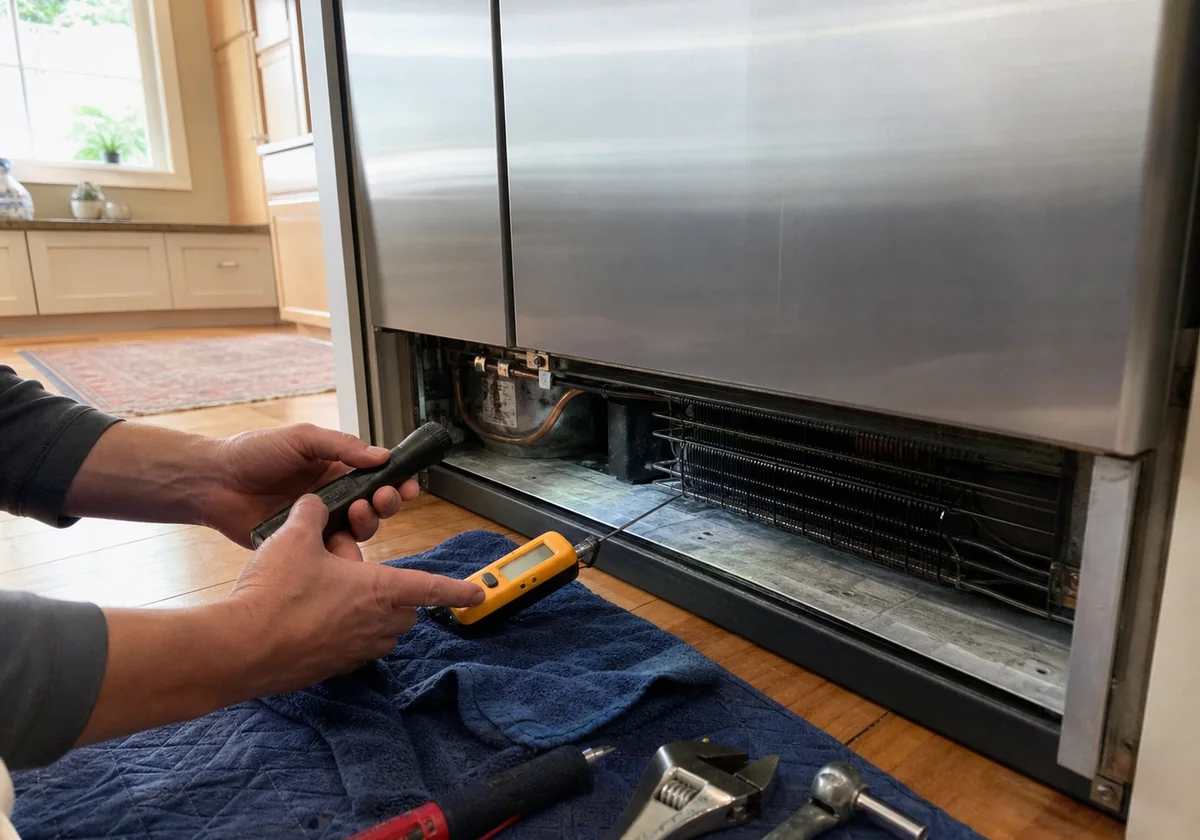
Of all the symptoms we get called about in Fremont, noise is the one owners describe most differently and worry about most. Part of that is the appliance: a Sub-Zero runs so quietly that any new sound feels alarming. Part of it is the install — a built-in is bolted into cabinetry, and that rigid surround turns a minor mechanical sound into something you can hear across the room and sometimes feel through the counter.
The useful news is that the noise itself usually tells us which part is involved before we ever open the unit. This page sorts the sounds into normal versus worth-a-call, walks the parts behind each one, explains why a Fremont built-in seems louder than the same machine would in a garage, and lists what to capture so the diagnosis is quick.
Decode the sound
Which noise means which part
Buzz or rising hum
A steady electrical buzz or a hum that climbs in volume is most often a fan motor on its way out — either the evaporator fan inside the compartment or the condenser fan behind the lower grille. As the bearing wears it drones, then buzzes, then eventually grinds. Caught at the buzz stage it is a quick fan-motor swap; left alone it can seize and stop the airflow a compartment depends on.
Rattle or vibration you can feel
A rattle that you can feel through the cabinet face is usually something loose: the lower grille, a panel, a fan shroud, or the compressor's own anti-vibration mounts gone hard with age. On an integrated unit set into millwork, a loose part does not just rattle — the cabinetry picks up the vibration and broadcasts it, which is why a small looseness reads as a big noise.
Grind or scrape
A grinding or scraping sound is a fan blade catching on built-up frost or a bearing that has run dry. This is the one noise we treat as time-sensitive, because a fan that is scraping is close to stopping, and a stopped evaporator fan warms the compartment fast.
Clicking or ticking
Rhythmic clicking every few seconds is often a relay or the icemaker valve cycling — sometimes a control trying and failing to start a component. Soft, occasional ticks and pops during a defrost are normal expansion and contraction and can be ignored. Repetitive, insistent clicking is worth a look.
Why it sounds worse here
Custom cabinetry turns Fremont kitchens into a sounding board
A great many Fremont built-ins live in kitchens that were remodeled around the appliance — the larger custom installs in Mission San Jose and the Vineyards, and the newer panel-ready builds along the Tesla corridor and through Warm Springs. Those installs look seamless precisely because the unit is married tight to the cabinetry, with panel fronts and minimal clearances. Acoustically, that hard, continuous structure is a sounding board: a fan bearing or a compressor mount that would be inaudible in a freestanding fridge transmits straight into the millwork and the countertop, so a fault you would otherwise never notice becomes a hum at the table.
This matters for the diagnosis. We do not chase the loudness — we find the source, then decide whether the fix is the part itself or also re-isolating it from the cabinet so the structure stops amplifying it. The same vibration path is why a wine column can disturb resting bottles even when it is cooling fine; that case is covered on the wine-storage temperature page, and the deeper mechanical faults on the sealed system and compressor page.
Do this first
What to capture before you call
- Name the soundBuzz, hum, rattle, grind, click or tick — each points at a different part. Get close and decide which word fits before you call.
- Record it on your phoneA ten-second video with sound is worth more than any description. Capture the noise at its loudest so we can match it to a fan, a compressor or the icemaker.
- Note when it happensConstant, only during a cooling cycle, only when the icemaker runs, or worse late on a hot Warm Springs afternoon? The timing narrows the cause as much as the sound does.
- Locate where it comes fromTop, back, behind the lower grille, or down at the compressor area. Press a hand gently on the cabinet face to feel whether it is vibration telegraphing through the millwork.
- Check the grille and leave the restA quick look for a loose lower grille or panel is fine. Skip pulling the unit or removing fan covers — that is where photos and your recording do the work instead.
A recording plus the timing turns a noise call into a targeted repair — see how a visit moves from symptom to proof on the technician process page.
FAQ
Noisy Sub-Zero questions from Fremont homeowners
Which Sub-Zero noises are normal and which are not?
Normal: a low compressor hum, an occasional gurgle as refrigerant moves, soft ticks and pops as parts expand and contract through a defrost, and the periodic clatter of cubes dropping into the bin. Not normal: a loud or rising buzz, a rattle or vibration you can feel through the cabinet, a grinding or scraping fan, or a rhythmic clicking that repeats every few seconds. The first group you can ignore; the second is worth a diagnosis.
Why does my Sub-Zero seem louder in a remodeled Mission San Jose kitchen?
Because the cabinet is the speaker. A built-in is screwed into custom millwork, and that hard, rigid cabinetry transmits and amplifies any vibration from a worn fan bearing or an out-of-balance compressor far better than the air gap around a freestanding fridge. The same minor fault that would be inaudible in a garage fridge becomes a noticeable hum at the dinner table in an integrated install.
My wine column hums and the bottles seem disturbed — should I worry?
Worth a look. A worn compressor mount or an unbalanced fan sends vibration straight into the racks, and that buzz can unsettle the sediment in reds meant to rest. We check the mounts and fan balance and quiet it down before it affects what you are storing — the same vibration story covered on the wine-storage page.
Is a loud Sub-Zero an emergency?
Usually not, but it is an early warning you should not sit on. A fan or bearing caught while it is merely loud is a small, bounded repair; left to run until it seizes, it can take out airflow and let a compartment warm. Record the sound and when it happens, then book a visit while it is still just noise.