
Symptom guide · Fremont
Sub-Zero freezer not freezing in Fremont
Soft ice cream, a warm freezer, slush in the ice bin — while the fresh-food side still feels cold. That split is not random. It is what dual refrigeration looks like when one of a Sub-Zero's two sealed systems is struggling, and it usually points to a bounded repair.
4.9/5 · 1,137 verified customer reviews
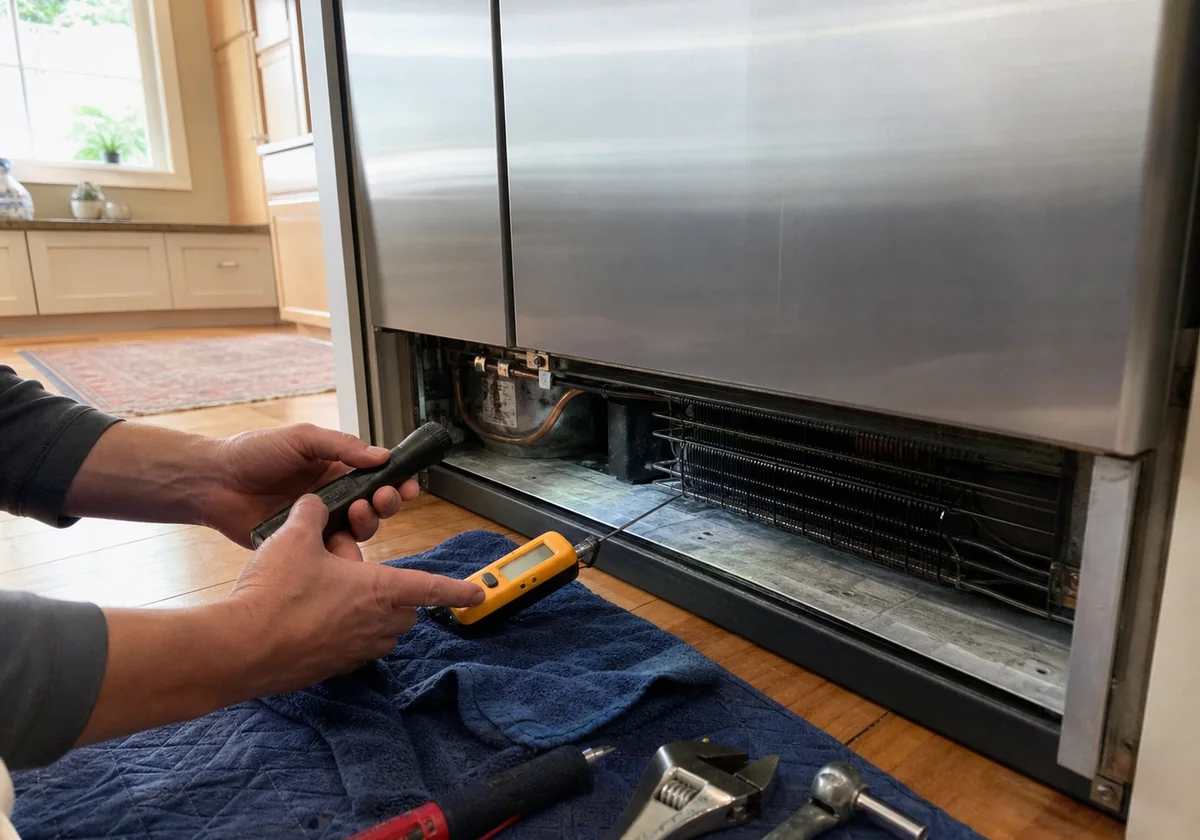
The call we get is almost always the same: the ice cream has gone soft and the cubes are clumping, but the milk and produce in the fresh-food side are still perfectly cold, so the owner is confused about whether the refrigerator is broken at all. On most refrigerators that combination would be strange. On a Sub-Zero it is the most diagnostic symptom there is — and it is good news, because it narrows the problem to one half of the machine.
Here is why a Sub-Zero freezer can fail while the fridge holds, the faults behind it that we see most in Fremont, the food-safety clock you are actually on, and the checks you can make before booking a visit.
The key idea
Dual refrigeration: two fridges in one cabinet
Almost every other brand cools the freezer and then bleeds some of that cold air over to the fresh-food side through a flap. Sub-Zero does not. Dual refrigeration gives each compartment its own sealed system — its own compressor circuit, its own evaporator, its own airflow — so the freezer can hold a true zero while the fresh-food side holds its own higher setpoint with moister air. It is the reason produce lasts longer in these units and the reason a Sub-Zero costs what it does.
It is also why a warm freezer with a cold fridge is a precise clue rather than a mystery. The two systems are independent, so when only the freezer slips, the fault lives in the freezer's own hardware: its evaporator, its fan, its defrost circuit or the air damper feeding it. We do not have to suspect the whole machine — and that usually keeps the repair bounded. If both compartments are warming together, that is a different path; start instead with the not-cooling diagnostic.
Likely causes
Why the freezer side slips in Fremont
The evaporator fan has stalled
The freezer makes cold at its evaporator and a fan pushes that cold across the compartment. When the fan motor wears out or ices up, the evaporator may still be cold but the air stops moving, so the freezer drifts warm even though the system is running. A silent freezer where you can still hear the fresh-food side working is the classic sign, and a fan motor is a stocked, everyday part.
The defrost system has frosted over
Each evaporator is defrosted on a timer so it does not ice up. If the defrost heater, sensor or control fails, frost builds into a wall across the back of the freezer until it smothers the coil and blocks its own airflow. The freezer climbs, the ice softens, and chipping at the frost only buys a day. This is a bounded electrical repair once we read which part in the circuit quit.
The air damper or sensor has drifted
A damper meters cold into the compartment and a thermistor tells the control how cold it actually is. A stuck damper or a drifted sensor leaves the freezer running too warm while reporting that all is well — which is why a real diagnosis reads the parts rather than trusting the display.
A dust-choked condenser starving the system
The freezer's sealed system can only hold zero if it can shed its heat. Fremont's long dry season packs the condenser coil behind the lower grille with fine dust, and in the inland heat of Warm Springs, the Tesla corridor and the Mission San Jose hills the compressor simply cannot reject heat fast enough. The freezer, with the coldest target in the box, is the first compartment to lose ground — exactly the load described in our Fremont inland-summer guide.
Food-safety clock
How much time you actually have
A freezer reading the high teens still keeps food frozen, but the buffer is gone. The deeper the freezer drifts toward freezing point, the faster ice crystals coarsen and the sooner anything that partially thaws and refreezes loses quality and, eventually, safety. The practical rule we give Fremont households: if the contents are still firm, move the irreplaceable items to a chest freezer or a neighbor's and book the repair; if anything has gone soft and slick, treat it as a same-day call. The sooner we read the freezer's own system, the more likely the food rides through and the repair stays small. Sealed-system work — covered on the sealed system and compressor page — is the expensive tier, and a fan or defrost fault caught early is what usually keeps you out of it.
Do this first
Safe checks before you call
- Read both compartment temperaturesPut a thermometer in the freezer and another in the fresh-food side and note both. A warm freezer with a normal fridge is the dual-refrigeration pattern; both warm is a different, whole-unit diagnosis.
- Listen for the evaporator fanOpen the freezer and listen. A silent freezer where the fridge fan still runs often means the freezer's own evaporator fan has stalled or iced over — a common, bounded fault.
- Look for a wall of frostHeavy frost on the back freezer wall points to a defrost-system fault: the evaporator is freezing solid and choking its own airflow. Do not chip at it; note it and photograph it.
- Check the condenser airflowGlance at the lower grille. If the coil behind it is matted with the fine dust a Fremont dry season leaves, that alone can keep the freezer from holding zero. Note whether it looks blocked.
- Photograph the model tag and stop thereCapture the model and serial inside the fresh-food compartment. Skip pulling the unit or forcing a manual defrost as a permanent fix — that erases the evidence we use to diagnose it.
If the display is also throwing an alarm, note the code before you reset — the Fremont error-codes page explains the common freezer-side alarms and which ones mean stop and call.
FAQ
Warm-freezer questions from Fremont homeowners
How can the freezer be warm when the fresh-food side is still cold?
Because a Sub-Zero is two refrigerators in one cabinet. Dual refrigeration gives the freezer and the fresh-food compartment their own sealed systems and their own evaporators, so one can fail or frost over while the other holds perfectly. A warm freezer with a cold fridge is actually a useful clue — it tells us the freezer's own evaporator, fan or defrost circuit is the place to look, not the whole machine.
My ice cream is soft but not melted — is that urgent?
It is an early warning rather than an emergency, but it is worth acting on. Soft ice cream means the freezer is running in the teens or low twenties instead of around zero. Food is still frozen but the margin is gone, so the next warm Warm Springs afternoon or a single frost-up can push it into the danger zone. Catch it now and the repair is usually a bounded part.
Could Fremont's heat be the cause?
It is often the trigger. The freezer's sealed system rejects its heat through the same condenser airflow the rest of the unit uses, and a dry inland summer in Warm Springs or the Mission San Jose hills packs that coil with dust. The compressor then cannot reject heat fast enough to hold zero, and the freezer is the first compartment to slip because it has the hardest target.
What can you do before I lose the food?
Move anything you cannot replace to a chest freezer or a neighbor's, then book the visit. Send a model-tag photo and two temperature readings — one from each compartment — so we arrive with the likely evaporator-fan, defrost or damper part for your model. Same-day routing in Fremont is realistic when capacity and the part allow.