
Symptom guide · Fremont
Sub-Zero refrigerator leaking water in Fremont
Water on the floor from a built-in Sub-Zero is one of the few faults that can hurt your house faster than the appliance. The good news: it almost never means the refrigerator has failed — a water path has clogged, cracked or stopped draining. Here is where Fremont leaks start and what to check first.
4.9/5 · 663 verified customer reviews
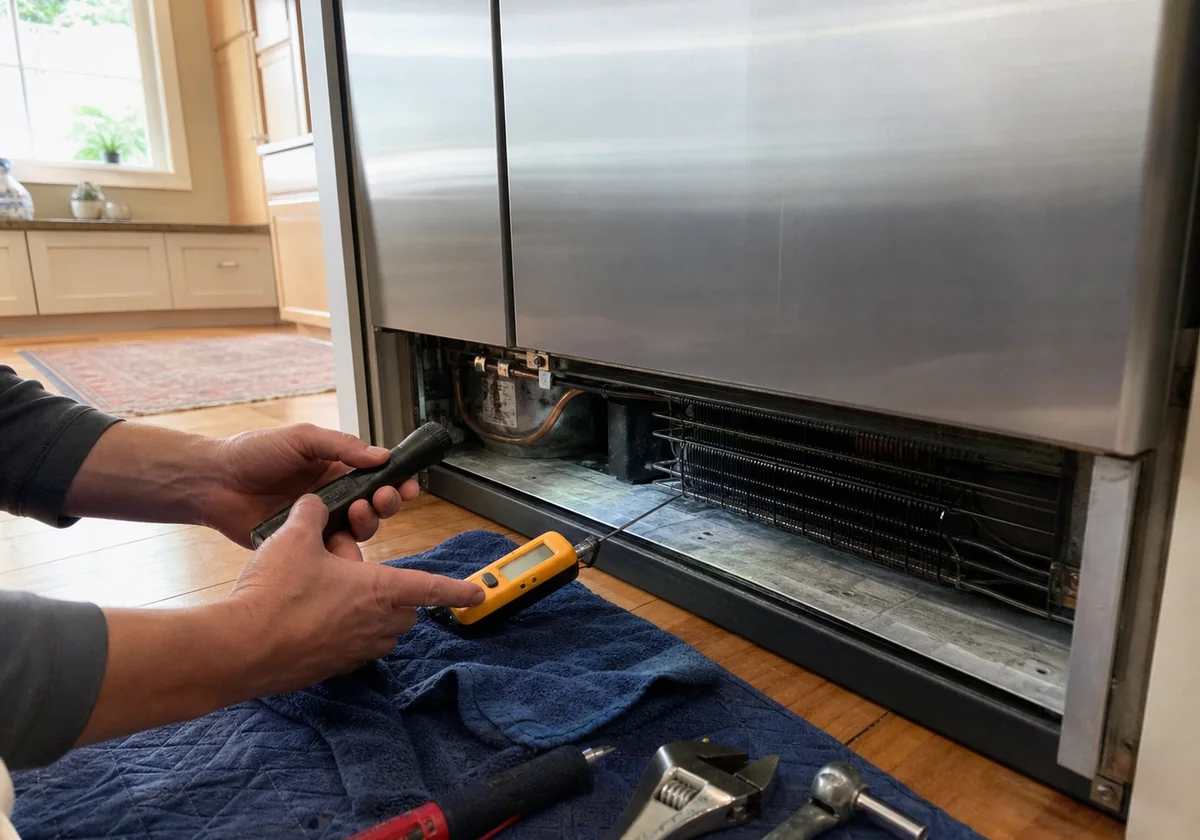
A Sub-Zero that leaves water on the kitchen floor earns priority on our Fremont routes for one reason: it damages the room before it damages the machine. The reassuring part is that on a built-in or integrated Sub-Zero a leak rarely means the refrigeration system itself is in trouble. Something in a water path has clogged, cracked or stopped draining — and most of those paths are bounded, well-understood repairs rather than the five-figure replacement owners fear when they see a wet floor under a $9,000 column.
Where the water shows up tells you most of what you need to know. A puddle that creeps out from under the toe-kick is a different fault from a soaked crisper drawer or a steady drip behind the dispenser. Below are the leak sources we actually find in Fremont kitchens, the checks you can safely make yourself, and the point at which the smart move is to stop and protect the floor.
Where it starts
The four places a Fremont Sub-Zero leak begins
1. A clogged defrost drain and ice plug
Every Sub-Zero runs a defrost cycle a few times a day. The meltwater is meant to run down a small drain at the back of the freezer floor, through a tube, and into a shallow pan near the compressor where the unit's own warmth evaporates it. When that drain clogs — with the fine mineral scale East Bay hard water leaves behind, or with a wad of frozen food sludge — the meltwater has nowhere to go. It backs up, freezes into a slab across the freezer floor, and finally overflows the front lip onto the kitchen floor. A sheet of ice under the bottom basket with a puddle out front is the classic signature, and it is the leak we clear most in Fremont's older Niles and Centerville homes, where decades of hard water have moved through original plumbing to the appliance.
2. A weeping water line, fill valve or filter head
The line feeding the icemaker and dispenser passes through a solenoid fill valve and, on most models, a filter housing — and any of those joints can weep. The valve diaphragm stiffens and stops seating, a plastic filter head develops a hairline crack, or a connection in the cabinet behind the unit works loose. Alameda County water is hard enough that mineral collects on the valve seat and holds it slightly open, giving a slow drip that gathers at one back corner rather than a dramatic flood. This is the leak we find most in the newer Warm Springs and Ardenwood builds, where the icemaker line was run during construction and has been under household pressure ever since.
3. Door-seal condensation
Fremont's dry inland heat is hard on gaskets. Over a few seasons a seal hardens until it no longer pulls flush, and warm, humid room air slips past it onto the cold cabinet wall, condenses, and runs down the inside of the door to pool in the channel or drip at the hinge. The tell here is moisture on the front edge or beads inside the door rather than a floor puddle. Mission San Jose hillside kitchens with big south-facing glass stay warm well into the evening, which loads the seal harder than a shaded flat near Lake Elizabeth ever sees.
4. Drip-pan overflow and blocked condensate
The evaporated meltwater has to land somewhere — the drip pan low in the chassis. When the condenser runs hard against a 95-degree Warm Springs afternoon it produces more condensate than usual, and a pan that has cracked, or been knocked askew during a cabinet remodel, sends that water onto the subfloor instead of evaporating it. This one hides the longest because there is no drama at the door; you simply find a damp toe-kick and a faint smell weeks later.
Do this first
Safe checks before you call
- Pin down where the water actually isA puddle creeping from under the toe-kick, a wet vegetable drawer, a sheet of ice on the freezer floor, and a drip behind the dispenser are four different faults. Note the exact spot before you call.
- Photograph the model and serial tagIt sits inside the fresh-food compartment on the cabinet frame or near the grille. A clear photo lets us match the right drain kit, valve or gasket to your model before the visit.
- Check the freezer floor for icePull the bottom basket and feel for a frozen slab under it. Ice there with a floor puddle points squarely at the defrost drain rather than the water line.
- Look at the back corners and the toe-kickA slow drip pooling at one rear corner suggests the fill valve, filter head or a line joint. If you can reach the shutoff behind or below the unit and the drip is water-line related, closing it stops the leak until we arrive.
- Stop there — do not open the sealed systemSkip prying off panels or pulling the unit out of custom cabinetry. Photos, the leak location and the model tag give us far more than a disassembly that risks the install.
A few minutes of looking saves a return visit: the leak location plus a model-tag photo usually tells us whether to arrive with a drain kit, a fill valve or a gasket. For the related water-side faults, see Sub-Zero ice maker and water line repair and door gasket and seal repair.
Why it matters here
A built-in leak does more damage in a Fremont kitchen
A freestanding fridge can be pulled out in two minutes when it leaks. A built-in or integrated Sub-Zero cannot — it is set into custom cabinetry with panels, water-line slack and tight clearances, so water has time to travel before anyone notices. In the slab-on-grade Ardenwood and Centerville homes that fill much of Fremont, a slow leak wicks under engineered flooring and spreads sideways under the cabinet run; in the hardwood kitchens common in Mission San Jose remodels it can cup boards before the puddle ever reaches open floor.
That is why we treat a leak as a time-sensitive call rather than a someday fix. When we arrive we confirm the model, find the actual water path, protect the floor and cabinet base, and quote against what we find. If the symptom turns out to be a warm compartment as well as water, that is a different diagnosis — start with the not-cooling diagnostic — but a clean leak with normal temperatures is usually a same-day-class repair. Planning ranges for the water-side jobs sit in the Fremont cost-by-symptom page, with the usual caveat that the final quote depends on model, part availability, cabinet access and diagnosis.
FAQ
Leaking Sub-Zero questions from Fremont homeowners
There is a sheet of ice across my freezer floor and a puddle out front — same problem?
Almost always, yes. That pairing is the signature of a blocked defrost drain. The freezer's defrost meltwater cannot reach its drain, so it freezes into a slab on the floor, then overflows the front lip onto the kitchen floor. Clearing and flushing the drain line usually fixes both at once.
Is it safe to keep using the refrigerator while it leaks?
For most leaks the cooling is fine, so your food is safe, but standing water on a hardwood or slab floor is not. Lay down towels, pull the unit's contents back from any wet area if you can, and avoid running the icemaker if the drip is at the back near the water line. Then book a visit before the floor or cabinet base takes damage.
Could Fremont's hard water really be causing this?
It is a bigger factor here than people expect. Alameda County water carries enough mineral to scale a fill-valve seat until it weeps, and to build a chalky sludge that clogs a defrost drain over a few years. We see it most in the older Niles and Centerville homes still on original plumbing, and in icemaker lines run during the Warm Springs and Ardenwood building boom.
How quickly can you come out for a leak?
Leaks are near the top of our priority list because they damage the house, not just the appliance. Same-day routing in Fremont is realistic when the request includes a model-tag photo, where the water is pooling, and your neighborhood, and when route capacity and the likely part allow.