
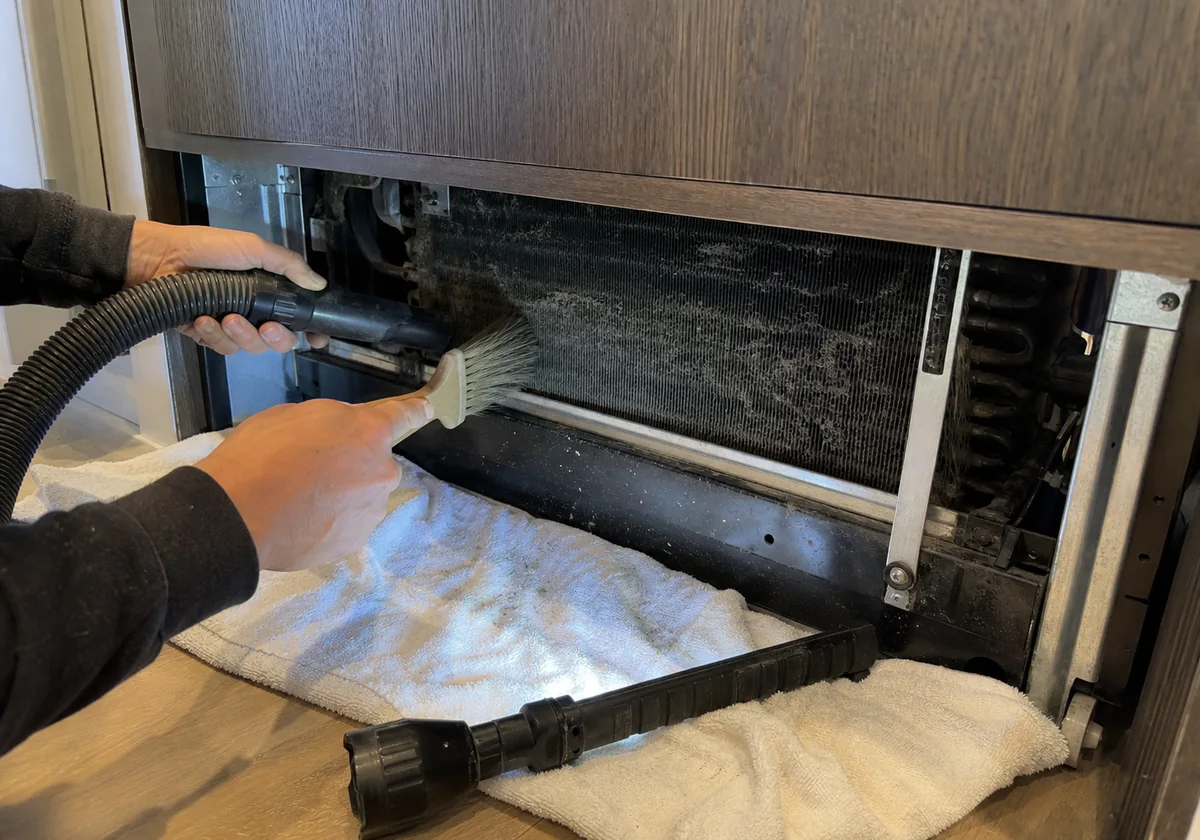
Fremont is not one climate. The flats out toward Ardenwood and the bay catch a breeze most afternoons, but the southern and eastern districts — Warm Springs, the Tesla corridor, the Mission San Jose hills below the old mission — bake. The marine air that cools Berkeley or Alameda barely reaches them, and a long dry summer keeps those kitchens warm into the evening.
A built-in Sub-Zero feels that heat more than most appliances in the house, because the room temperature it has to fight is exactly what decides how hard its sealed system works. Below is what the season does and the short maintenance list that keeps it from turning into a service call.
Why a hot room is the real load
A built-in refrigerator sheds heat by pulling room air across a condenser coil behind the lower grille. When that room is 78 degrees in a Warm Springs kitchen on an August evening, the unit is dumping heat into air that is already warm, so the compressor runs longer and the cabinet struggles to recover after the door opens. Set the same fridge in a cooler coastal kitchen and it loafs along.
That is why the same Sub-Zero model gives us more warm-running calls in Fremont's inland pockets than it does a few miles west. The appliance is fine; the room is working against it.
Dust, not damp, is the local enemy
Where a foggier town fights moisture, dry inland Fremont fights dust. A long rain-free stretch plus open windows leaves a fine grit that packs into the condenser coil and chokes airflow. A clogged coil is the single most common reason we find a Fremont unit can't hold temperature in late summer — the compressor is fine, it just can't reject its heat through a blanket of dust.
Gaskets take a beating too. Dry heat hardens door seals over a few seasons, and a stiff gasket that no longer pulls flush lets warm room air leak in along the hinge side, right where you won't notice it until the freezer starts frosting.
The short list that gets ahead of it
Two things, once a year, ahead of summer: vacuum and brush the condenser coil clean, and check the door gaskets for a flush, even seal all the way around. That is the highest-value hour an owner in Mission San Jose, Centerville, or Warm Springs can spend on the appliance.
It keeps the compressor cool through the hottest months, catches a hardening gasket before it frosts the box, and heads off the sealed-system repair that a season of running hot against a choked coil eventually invites. If the coil is buried behind a built-in surround you can't reach, that is exactly the kind of visit we make on our regular East Bay rounds.