
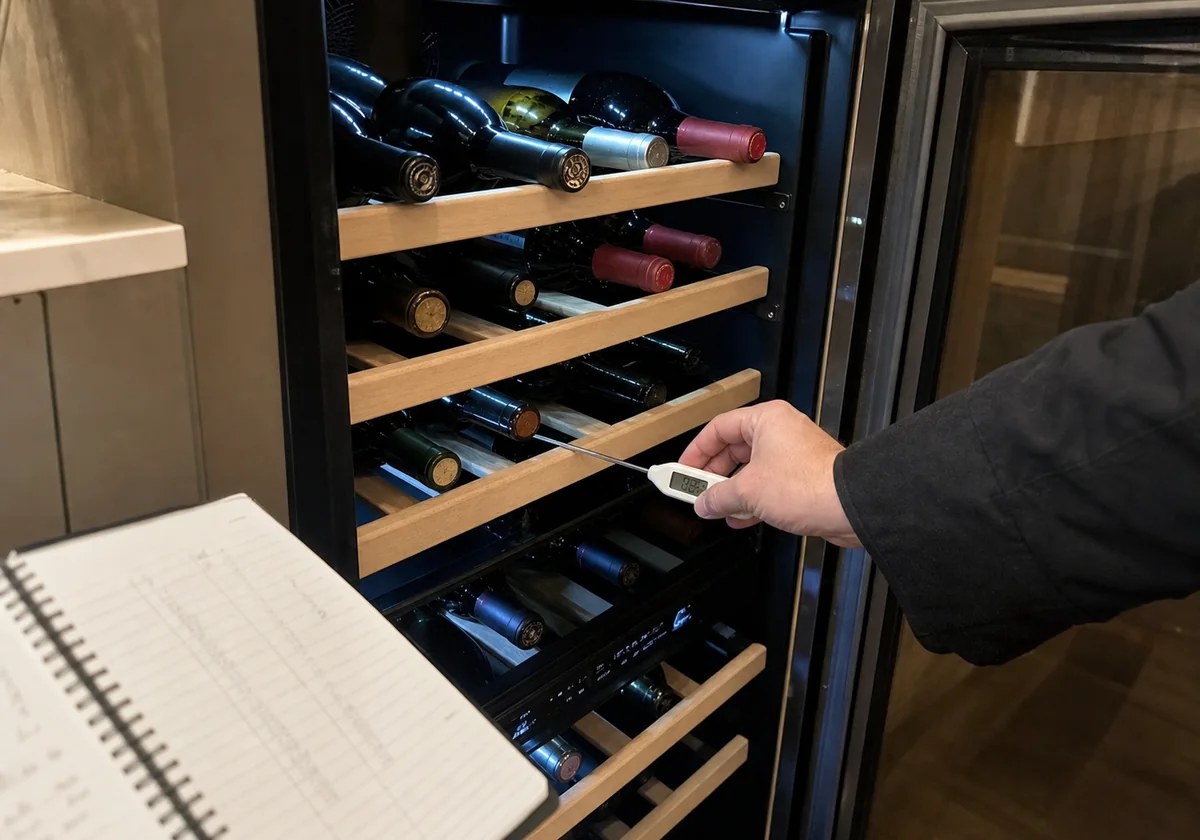
The wine cabinets we get called to in Fremont sit in two kinds of homes: the hillside estates above Mission San Jose where a serious cellar is built into the kitchen, and the newer Warm Springs and Tesla-corridor builds where a 30-inch Sub-Zero wine column anchors a butler's pantry. Both share a problem the appliance can't escape — Fremont's long, dry inland summer keeps the surrounding room warm well into the evening, and that warm room is precisely what a wine unit has to overcome to hold a steady cellar temperature.
When one of these columns starts drifting off its set point, the wine notices before the owner does. Here is what a Sub-Zero wine cooler is usually telling you, and how we sort a small fix from a sealed-system job.
Dual zones, and why one of them slips
Most Sub-Zero wine columns run two independently controlled zones — a cooler band near 50 degrees for whites and sparkling, a warmer band near 58 for reds — each with its own sensor and damper feeding off one sealed refrigeration system. That split is the whole point of the cabinet, and it is also where the most common Fremont complaint shows up: one zone holds while the other drifts warm or swings a few degrees through the day.
When a single zone misbehaves, the sealed system is almost always fine. The usual culprit is a drifted zone sensor reading the air wrong, or a damper or small zone fan that has stopped moving cold air evenly between the two compartments. Those are bounded, genuine-part repairs — far less involved than people fear when they see a $7,000 cabinet acting up.
Heat, dust, and the things that load the system
A wine column rejects its heat through a condenser behind the lower grille, same as a built-in refrigerator, and Fremont's dry inland air is hard on it. A long rain-free stretch packs fine grit into that coil until it can't shed heat, and the compressor runs longer and longer trying to hold a cellar temperature against a warm Mission San Jose kitchen. A choked condenser is the single most common reason a whole cabinet — both zones — slowly loses its grip on temperature.
The sealing details matter too. The UV-tinted glass door rides on a gasket that, like any seal in dry heat, hardens over a few seasons until it no longer pulls flush, and warm room air leaks in along the edge. And because wine throws sediment, a unit with a noisy, vibrating compressor mount isn't just loud — that buzz travels into the racks and disturbs bottles meant to rest. A failing evaporator fan, a tired gasket, and an out-of-balance compressor are the airflow-and-vibration faults we check whenever a column runs warm or loud.
Repair, or replace the cabinet?
A Sub-Zero wine column is built to be serviced, and the math usually favors repair. A sensor, a damper, a fan motor, a door gasket, or a control board is a small fraction of replacing an integrated cabinet that's tied into custom millwork — the kind of install common in the remodeled Mission San Jose kitchens we visit. We start every call with a $89 diagnostic, read both zones and the sealed-system pressures against spec, and quote the actual fault.
The one case where replacement enters the conversation is a refrigerant leak or failed compressor on a much older cabinet. Sealed-system work means recovering, repairing, and recharging the closed loop — real money — and on an aging unit we'll put the readings in front of you rather than sell a repair that doesn't pencil out. On anything reasonably current, fixing the column you have is almost always the right call.